Structure
The rural health fund will provide $50 billion in grants to states over five years.
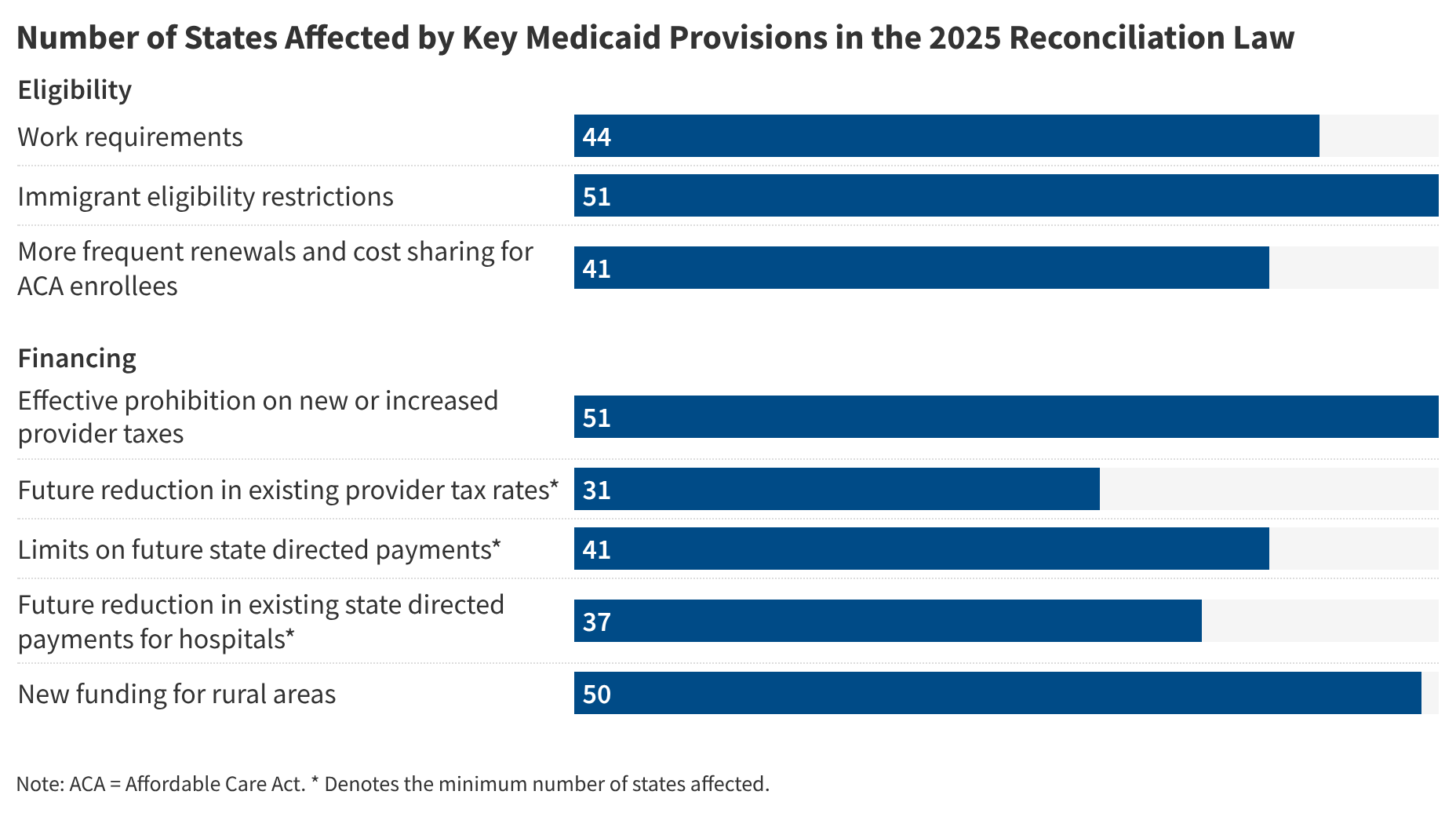
The rural health fund was added to the 2025 reconciliation law as a political compromise just prior to the law’s passage. The fund emerged during Senate negotiations in response to concerns about the impact of federal spending cuts on rural hospitals. Nonetheless, the program is not specific to rural hospitals but instead supports a much broader set of activities (see below). The law specifies that the Centers for Medicare & Medicaid Services (CMS) will oversee the program. It grants the agency substantial leeway to determine how to distribute funding across states and flexibility to expand the permitted uses of funding and determine the terms and conditions. CMS is administering the program through the new Office of Rural Health Transformation.
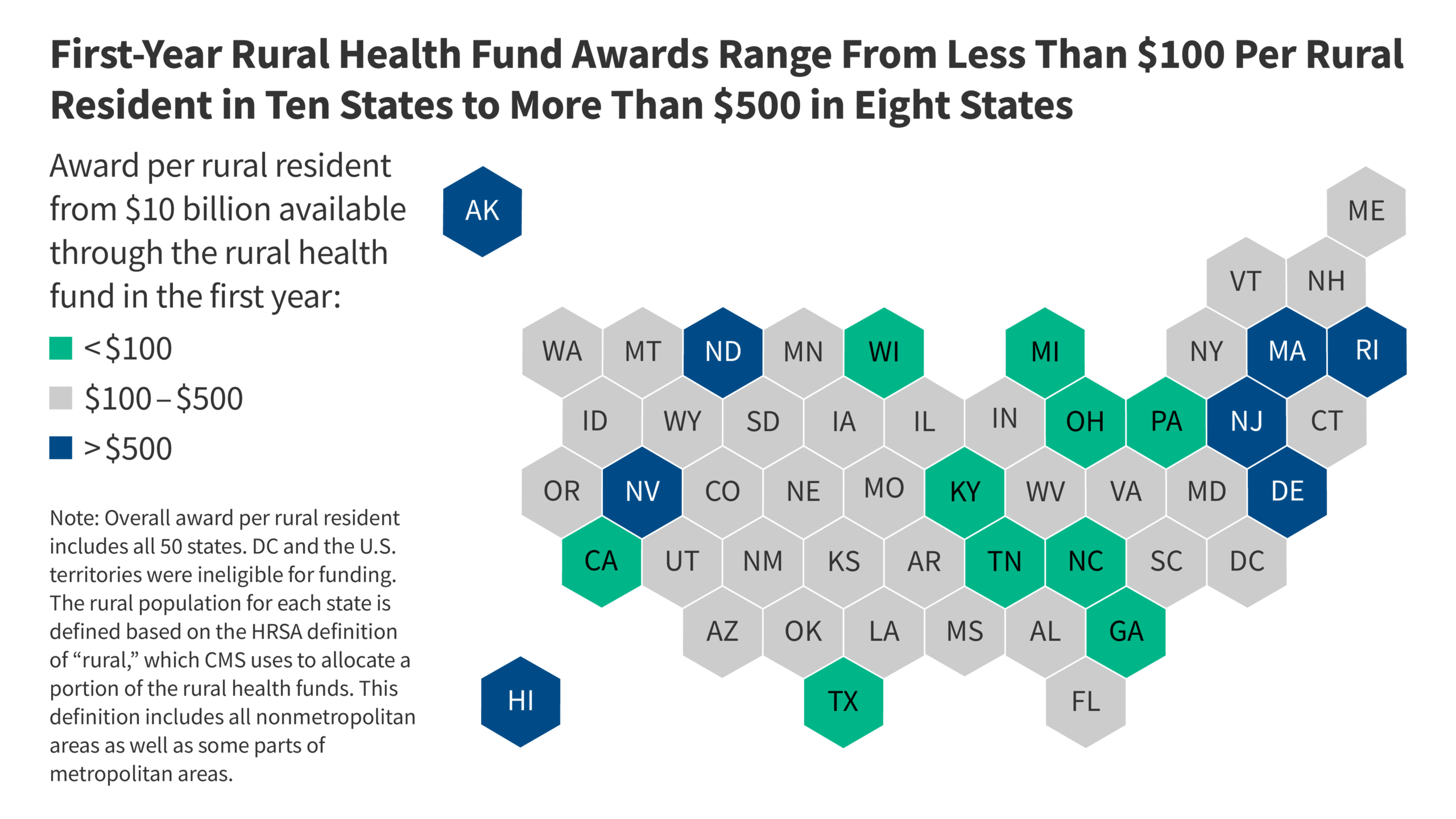
Under the rural health fund, CMS will award $10 billion in grants to approved states each year from fiscal years 2026 to 2030, a five-year period, for a total of $50 billion. States will be allowed to spend funds that they receive at a given point through the end of the following fiscal year, and CMS will redistribute any unused funds over time, but all funds must be spent by the end of fiscal year 2032. States will administer their programs, subject to terms agreed upon with CMS. However, the funding is occurring through a mechanism known as a “cooperative agreement,” which “require[s] substantial CMS project involvement after an award is made.”
States had a one-time opportunity to apply for funding and all states were approved, meaning that they are eligible for funding for all five years of the program. However, CMS may withhold, reduce, eliminate, or recover funding over time if it determines that a state is not in compliance with program rules, the state has not made “satisfactory progress,” or that funding is no longer “in the government’s best interest.” The law indicates that there will be no administrative or judicial review of these and other funding decisions made by CMS.
The law and CMS established a fast-paced timeline for states to apply for funding and initiate programs during the first year of the program. CMS issued a Notice of Funding Opportunity in September 2025 with guidance on how to apply. States then had less than two months to prepare their applications. Those applications affect the scope of activities states can engage in and the amount of funding they receive for the life of the program. CMS announced first-year awards in December 2025. States were then given less than a year to finalize their plans through discussions with CMS, develop their own application process for entities within the state to receive funding, process applications, obligate funding, and submit their first annual progress reports (which will affect second-year awards). States likely differ in their capacity to manage procurement processes and have varied widely in terms of how quickly they have distributed funds during the first year.
Key Dates
Enactment and State Applications
- July 4, 2025: The 2025 reconciliation law is enacted. The law includes large cuts to federal health care spending and the creation of the rural health fund.
- September 15, 2025: CMS releases Notice of Funding Opportunity that includes guidance on how CMS will administer the program and how states can apply.
- November 5, 2025: Deadline for states to apply.
First-Year Awards (fiscal year 2026)
- December 29, 2025: CMS announces awards, totaling $10 billion.
- Following first-year award announcement: States work with CMS to reconcile their plans with awarded amounts and program requirements and to determine how funds will be apportioned across initiatives, after which CMS makes first-year funding available.
- August 31, 2026: Deadline for states to submit first of five annual reports.
- October 30, 2026: Deadline for states to obligate funding.
- November 29, 2026: Deadline for states to submit first of thirteen quarterly reports.
- September 30, 2027. Deadline for states to spend first-year awards. CMS will redistribute unused funds in fiscal year 2028.
Second-Through Fifth-Year Awards (fiscal years 2027-2030)
- October 31 of fiscal year: CMS will announce fiscal year awards totaling $10 billion by this date.
- September 30 of following fiscal year: Deadline for states to spend awards. CMS will redistribute unused funds in the following fiscal year.
Program Wind-Down
- February 27, 2031: Deadline for states to submit final report.
- September 30, 2031: Deadline for states to spend fifth-year awards. CMS will redistribute unused funds in the next fiscal year.
- September 30, 2032: Deadline for states to spend any remaining dollars redistributed by CMS.
- October 1, 2032: Unused funds returned to Treasury Department.
Uses
The rural health fund is intended to transform the delivery of health care in rural communities and is being used to support a wide variety of activities.
The rural health fund is designed to help “support…rural communities to improve healthcare access, quality, and outcomes through system transformation” according to CMS. CMS also indicated that it “expects States to design initiatives that invest in long-term, sustainable improvements rather than temporary fixes or funding perpetual operating expenses.” States can use funding for eleven purposes detailed in law and through guidance from CMS, with certain restrictions (see textbox below and Appendix Table 1). CMS has also identified five strategic goals of the program that align with these uses: make rural America healthy again, sustainable access, workforce development, innovative care, and tech innovation (see Appendix Table 2).
In line with the broad scope of the rural health fund, states are implementing a wide variety of activities under the program. For example, states are using funds to promote prevention and chronic disease management interventions, support collaboration among rural health care facilities (such as by sharing administrative services) and between rural providers and regional health systems, recruit clinical workers to rural areas, promote technological advancements (such as by expanding telehealth or promoting AI diagnostic tools), invest in existing hospital buildings and infrastructure, help hospitals determine which services should and should not be maintained, and support the adoption of value-based care and alternative payment models.
Specific state examples include the following (each state is undertaking multiple initiatives):
- Alabama is funding the use of telerobotics to provide ultrasounds remotely.
- Alaska is funding the use of drones to deliver medications to remote areas.
- California is funding new provider collaboration networks, connecting regional hospitals with critical access hospitals, clinics, birthing centers, and other providers.
- Michigan is funding an initiative to bring “services closer to where people work and live,” such as by “expanding…home-based care for older adults to allow them to age in place.”
- North Carolina is increasing access to healthy foods, such as by “facilitat[ing] farm-to-hospital [programs], mobile food markets, and community-based food access.”
- Montana is helping rural hospitals “right size” their services, which could entail eliminating some service offerings to improve hospitals’ financial sustainability.
- Nevada is funding an expansion of its rural workforce, such as through provider recruitment incentives.
Permitted Uses
States must use funding for at least three of the following permitted uses.
- Promote consumer tech solutions. For the prevention and management of chronic diseases. Examples include remote patient monitoring (e.g., through wearable devices), apps that connect patients with providers and health information, and digital health tools in community access points. States can also provide seed funding for innovative, high-impact tech solutions through a Rural Tech Catalyst Fund, subject to spending restrictions.
- Support IT advances. Such as by expanding access to telehealth, upgrading or replacing electronic health record systems (replacements are subject to spending restrictions), facilitating health information exchange and interoperability, enhancing cybersecurity, and promoting artificial intelligence for clinical and administrative uses.
- Provide training and technical assistance for technology that improves care delivery in rural hospitals. Such as for “remote [patient] monitoring, robotics, artificial intelligence, and other advanced technologies.”
- Recruiting and retaining clinical workers. Such as by promoting health careers among local high school students, developing new residency and fellowship programs, offering advanced training for clinical workers, and providing tuition reimbursement or other incentives. Clinical workers who directly benefit must commit to serve rural areas for at least five years.
- Improving prevention and chronic disease management. Such as through screening and early detection (e.g., mobile cancer screening), nutrition education, improving access to healthy food and to outdoor activities, early maternal and infant interventions (e.g., home visits), and care management programs.
- Matching service offerings to local need. Such as by expanding access through telehealth, mobile units and satellite sites, strengthening emergency medical services, and providing non-medical transportation. This could also include “right sizing” delivery systems by eliminating services that cannot be sustained.
- Paying providers for health care items or services. Provider payments are subject to a number of restrictions: they cannot exceed 15% of a state award in a given budget period, be used for short-term relief, supplement or duplicate existing funding sources (including Medicaid), or cover gender-affirming care or most abortion services. Examples of permitted uses include incentive payments for providers to improve quality or reduce costs.
- Supporting innovative models of care. Including value-based care arrangements and alternative payment models. Such as by helping providers participate in the Achieving Healthcare Efficiency through Accountable Design (AHEAD) model (which, among other things, replaces traditional hospital reimbursement from multiple payers with global budgets for a given facility).
- Investing in existing health care facility buildings and infrastructure. Investments cannot exceed 20% of a state award in a given budget period and cannot be used for new buildings or equipment. Examples include repairing existing buildings and equipment, minor renovations, interior modifications, upgrading lighting and electrical systems, and installing or upgrading security systems.
- Fostering collaboration among providers. Such as through hub-and-spoke models (which connect anchor facilities, like larger regional hospitals, with local “spokes,” like clinics and small rural hospitals), shared services or group purchasing (e.g., of administrative services), or clinically integrated networks (groups of providers that join together to improve care and reduce costs without formally merging).
- Supporting access to behavioral health care services. Such as through telehealth options, substance use disorder and opioid treatment, Certified Community Behavioral Health Clinics, and mobile crisis teams and centers.
States may also use up to 10% of their award in a given budget period on administrative expenses. Program restrictions listed above are not comprehensive.
Uses for Hospitals
Rural health funds are not just for hospitals, and there are restrictions on how hospitals can benefit.
While the fund emerged in response to concerns about the impact of the reconciliation law on rural hospitals, the extent to which it will benefit these facilities is unclear. States can choose how much of the funds will go to hospitals versus other rural providers and various other entities, such as contractors providing technical assistance, universities participating in workforce initiatives, regional health systems in urban areas collaborating with rural providers, and vendors developing new health technologies. Of the dollars going to rural hospitals, it is not yet clear which specific facilities will receive funding and the extent to which states will target resources to particular types of hospitals, such as those that are isolated or in financial distress. Additionally, hospitals that are not in rural areas can also receive funding, as long as it is to the benefit of rural communities and residents.
Initiatives could benefit hospitals to varying degrees. For example, uses of the funds that could more directly benefit hospitals include investing in existing hospital infrastructure (permitted within limits), strengthening collaboration among rural facilities and other providers, and supporting alternative payment models. Other initiatives, such as programs to promote health literacy and healthy behaviors, may have less direct or no obvious benefits for hospitals. The benefit to rural hospitals—and to other providers, patients, and rural communities—will also depend on how effective state initiatives are, which is difficult to predict.
While funding could benefit hospitals in a number of ways, there are also limitations on how it can do so. For example, CMS guidance indicates that rural health funds cannot be used for:
- Propping up struggling hospitals with temporary relief. The funds are not intended “to be used for perpetual operating expenses, but rather for investments…that will have sustainable impact beyond the end of the program,” according to CMS.
- Payments to providers for care that exceed 15% of a state award in a given budget period. Payments to providers must be related to the strategic goals of the program, such as bonus payments for providing high-quality care, and cannot be used to supplement or duplicate existing funding, including payments from Medicaid or private insurance.
- Construction, building expansion, or purchasing buildings, though they can be used for certain investments in existing rural health care facility buildings and infrastructure, not to exceed 20% of a state award in a given budget period.
- Replacements for previous HITECH-certified electronic medical record (EMR) systems that exceed 5% of a state award in a given budget period.
- Funds for gender-affirming care (a limitation that is not restricted to care for minors, as are many other federal measures) and reimbursement for most abortion services. There are also limitations related to “citizenship documentation requirements for payments made with respect to an individual.” Many hospitals do not currently collect patient immigration status but may need to do so to be reimbursed for patient care with rural health funds.
The rural health fund may help hospitals adapt to the loss of federal funding under the reconciliation law, though the extent to which it will do so is unclear. The reconciliation law made historic reductions in federal support for health care and is expected to result in an unprecedented increase in the number of people without health insurance. An increasing uninsured rate results in fewer patients with health coverage for hospital care, and an increase in the amount of uncompensated care hospitals provide. At the same time, the 2025 reconciliation law made significant changes to Medicaid financing that could result in major reductions to the rates Medicaid pays for hospital services in most states.
Just as it is unclear how much hospitals will benefit under the rural health fund, it is also hard to predict how much hospitals will lose due to spending cuts under the reconciliation law. As detailed below, the rural health fund is smaller than estimated cuts to federal Medicaid spending when looking at rural areas in aggregate, and most of the cuts will persist over time, in contrast to the rural health fund.
The hospital industry and some members of Congress have called for a greater focus on hospitals. The hospital industry has recommended that the rural health fund give greater priority to supporting rural hospitals, including by lifting restrictions on provider payments and capital investments. A group of Senators also recommended that the program focus more on rural hospitals and other rural providers and expressed concern that small rural providers will have a harder time vying with larger systems and organizations for funding. Increasing funding for rural hospitals would do more to address concerns about the financial standing of these facilities, an original motivation for the program, but would involve tradeoffs with competing initiatives.
Publisher: Source link