Accessing Health Information
The majority of reproductive age women (87%) and men (86%) have looked for health information or advice online either through an internet search engine, social media, or AI tools. Most reproductive age women (83%) and men (81%) have used internet search engines, such as Google or Bing, in the past year to look for health information or advice (Table 1). Women are more likely than men to use social media to search for health information (44% vs. 38%) but are as likely to look for health information through an AI tool or chatbot such as ChatGPT, Google Gemini, or Claude (42% for women vs. 46% for men). Nearly one in four (24%) women say they have used all three methods — internet search engines, AI tools, and social media — to search for health information (data not shown).
Larger shares of Asian (55%) and Hispanic (44%) women say they used AI tools or chatbots for health information in the past year compared to White women (39%). In general, smaller shares of people report using social media platforms for health information or advice. However, half of Asian (50%) and Hispanic (48%) women report looking for health information or advice on social media compared to four in ten White women (41%). Over half (53%) of women ages 18 to 25 also report using social media for health information. Larger shares of women with low incomes looked for health information on social media compared to women with higher incomes (48% vs. 41%). This aligns with previous KFF polling findings that have found younger adults and adults with lower incomes are more likely to use social medial for health information and are more likely to say they do so because they can’t afford to see a provider or don’t have a regular provider.
The survey asked whether individuals sought information about different health topics through these various platforms and nearly half of reproductive age women say they sought information about mental health (47%) (Table 2). This rose to 57% of women ages 18 to 25. A quarter of women of reproductive age (26%) sought information about menopause online, but almost half (46%) of women between the ages of 36 and 49 looked for this information online. Three in ten women of reproductive age (30%) say they looked for information about pregnancy and childbirth. However, among women who were pregnant or gave birth in the past three years, seven in ten (71%) report seeking information about pregnancy and childbirth online (data not shown in table). One in three (33%) women ages 18 to 25 sought information about contraception and one in six (18%) sought information about abortion.
Slightly smaller shares of reproductive age men sought health information through social media (38% vs. 44%) compared to women, but similar shares looked for information via internet search engines (81% vs. 83%) and AI tools and chatbots (46% vs. 42%). Of the health topics the survey asked about, the largest share of reproductive age men sought information about mental health (42%), including over half (54%) of men ages 18 to 25 and 47% of men ages 26 to 35. Over a quarter (27%) of men looked for information about testosterone levels and 16% searched for information about erectile dysfunction. Not surprisingly, fewer men than women looked for information about pregnancy and childbirth, but nearly one in four (22%) men ages 26 to 35 did. One in ten (10%) reproductive age men sought information about vasectomies and 6% of men looked for information about abortion, although 13% of men ages 18 to 25 looked for information on abortion.
Regardless of whether they sought it out, one in three (35%) women of reproductive age have seen or heard something about contraception on social media in the past 12 months, with larger shares of younger women reporting exposure (Figure 1). Social media has become a common place for people to view information about contraception. Of those who have seen or heard something about contraception on social media, 78% report using contraception in the past 12 months with the majority using hormonal methods (62%) (data not shown). A larger share of contraceptive users report seeing information about contraception on social media compared to non-contraceptive users (38% vs. 27%).
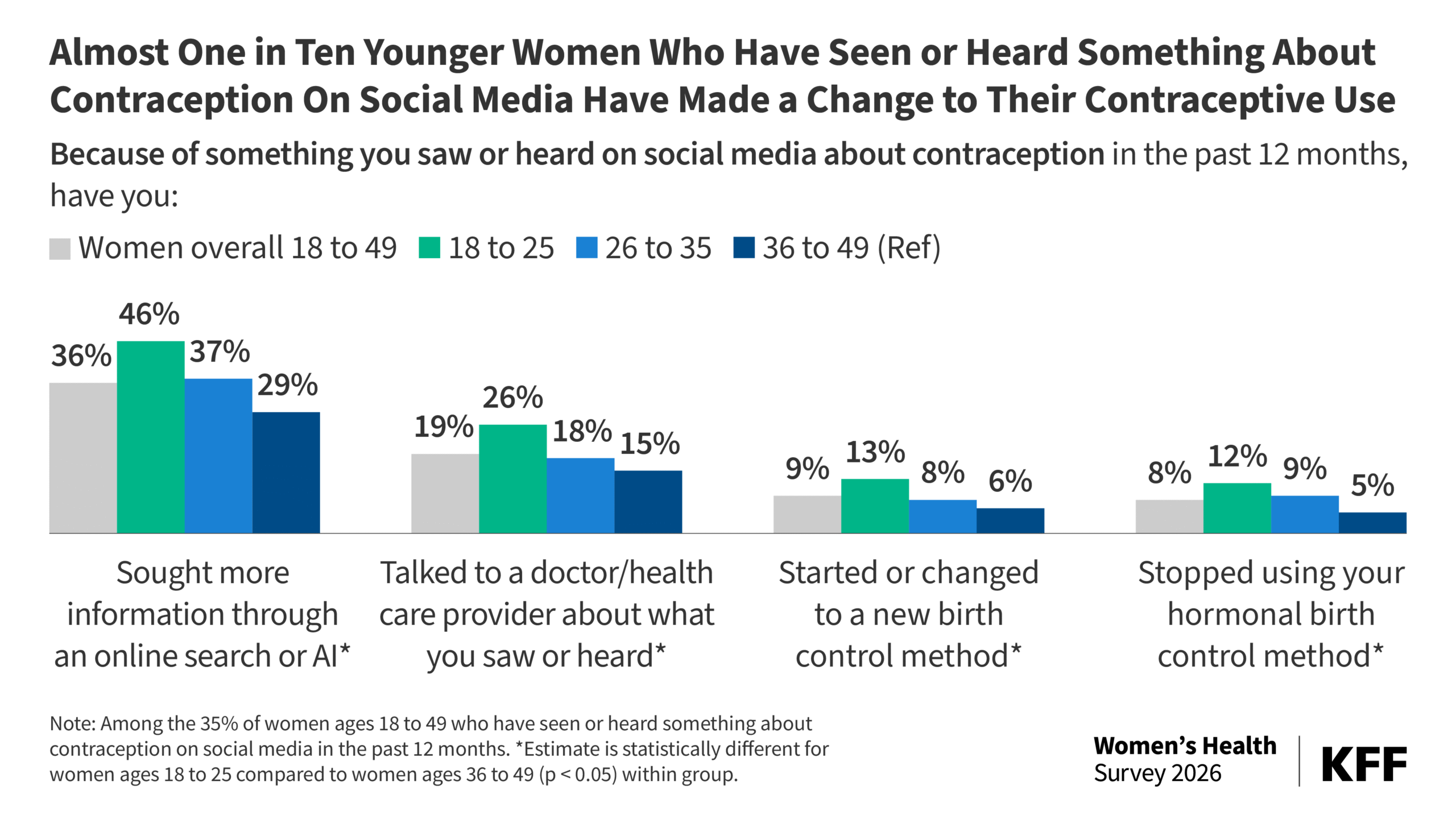
Contraceptive information seen online can lead women to seek more information or make a change to the contraceptive practices. One in ten women who saw contraceptive information on social media said they changed their contraceptive use behavior, such as stopping their hormonal birth control (8%, 3% of all women ages 18 to 49) or starting or changing to a new birth control method (9%, 3% of all women ages 18 to 49), one in five (19%) who saw contraceptive information (7% of all women ages 18 to 49) talked to a doctor or health care provider about what they saw or heard, and a third (36%) sought more information through an online search or AI (12% of all women ages 18 to 49) (Figure 2). Larger shares of young women ages 18 to 25 compared to women ages 36 to 49 stopped using their hormonal birth control (12% vs. 5%), started or changed to a new birth control method (13% vs. 6%), sought more information from a doctor or healthcare provider (26% vs. 15%), or sought more information through an online search or AI (46% vs. 29%).
False or Misleading Statements About Contraception
Many women report seeing content on social media or elsewhere that promotes contraceptive misinformation. The survey asked whether women had seen or heard four widely spread pieces of contraceptive misinformation (Table 3). About half (53%) of women of reproductive age had seen or heard that hormones in contraceptives are harmful to your health and about four in ten (43%) had seen or heard that hormones in contraceptives limit your ability to get pregnant in the future. Women of color report lower exposure to hearing that hormones are harmful, while larger shares of young women had been exposed to this false statement.
Natural family planning or fertility awareness-based methods have been promoted on social media to appeal to people who erroneously think hormones are harmful to your health or those who are seeking non-hormonal methods. One in three (32%) reproductive age women say they have seen or heard that natural family methods are as effective as hormonal contraceptives at preventing pregnancy. Natural family planning methods fall under fertility awareness-based methods, which the American College of Obstetricians & Gynecologists say are 77%-98% effective at preventing pregnancy, whereas hormonal contraceptives are 93-99.9% effective.
One in three (32%) reproductive age women have seen or heard on social media that emergency contraceptive pills, such as Plan B, cause abortions, which is also untrue. Emergency contraceptive pills cannot terminate an existing pregnancy, cannot prevent the implantation of a fertilized egg, and cannot affect a developing embryo.
Trusted Sources for Health Care Information
When asked who they trust to provide reliable health information, the majority of reproductive age women say they trust their health care provider a great deal or fair amount (86%) slightly higher than 79% of reproductive age men (Figure 3 and Table 4). While trust in health care providers is consistently highest across different groups, it declines slightly among lower income groups (Table 4). Over half (55%) of all women also say they trust state and local health departments and even higher shares of Asians (63%) and Democrats (64%) trust these sources.
The survey also finds one quarter (25%) of reproductive age women trust AI tools and chatbots a great deal or a fair amount for reliable health information, which is similar across demographic groups. A higher share of reproductive age Asian women trust AI tools or chatbots. Few women trust social media and social media influencers (15%) for reliable health care information; however, this rises to over one in five (21%) 18- to 25-year-women.
About half (48%) of women ages 18 to 49 trust federal health agencies a great deal or fair amount for reliable health care information (Figure 3). This comes after a year of significant layoffs of federal health workers and changes to federal health websites like the Centers for Disease Control and Prevention (CDC) and Health and Human Services (HHS). About a quarter (26%) of reproductive age women say they trust the head of HHS, Robert F. Kennedy Jr. to provide reliable health care information.
Publisher: Source link