LOS ANGELES — Uber Health is rolling out a new feature that allows patients who are comfortable with its platform to book their own rides.
Uber’s healthcare platform has traditionally been a back-end option for providers and other partners to book rides to and from appointments on the behalf of the patient. Through this approach, Uber supported processes like transportation benefits and discharge planning for its partners.
However, the company heard feedback from clients that the administrative time to do this was not insignificant, and that there were many patients who were familiar enough with Uber to book trips themselves, Cory Warner, global head of growth and operations for Uber Health, told Fierce Healthcare in an interview at ViVE on Tuesday.
“We’re really excited, because we’ve been able to advance the technology to meet the needs of some of our customers who’ve been sharing with us that, while we have a lot of folks that may not have a smartphone, we do have a number of patients and members who have the Uber app in their everyday life,” she said.
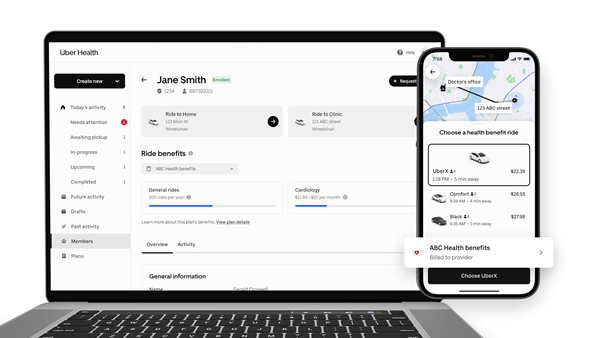
In the platform, Uber Health customers can upload the details on eligible members, who then receive a text message to sign up through the app. Their benefits are then applied to their Uber Wallets for use, the company said.
The patient can then pre-schedule or request rides using the benefit, and track their utilization in the app. Utilization data is also fed back to the client through the dashboard, Uber said. Uber Health clients can also set parameters around ride length or budget.
Warner said the platform offers greater autonomy for the patients that want it as well as reduces the workload on the partner side. For example, Uber is piloting the self-booking option with organizations for individuals with intellectual and developmental disabilities, many of whom deeply value that ability to maintain autonomy.
In addition, Uber is piloting the platform with Ronald McDonald House New York, which is using it to support rides for families that are funded directly through the organization.
With the self-booking option available, Uber has seen a significant reduction in patients canceling rides or missing connections, the company said. Early pilot results show a decrease of 86%.
Warner said the simplicity of the approach has been a key positive in the pilot phase. For instance, because the rider is tracking the ride in their personal app, they can follow the map more closely than they would be able to otherwise.
“While this is simple and simple to set up, simple to manage, which is all that we’re looking for — the less noise, the better within this space,” she said.
She added that given Uber’s global reach, the company sees the potential to expand this platform beyond the United States and support transportation and access in other countries, too.
“As a global organization, we have the ability to apply this at scale,” she said. “What we always think about is evaluating the specific needs of the market, because there’s not a one-size-fits-all.”
Publisher: Source link