Antibiotic resistance is already one of the biggest health challenges facing the world today. Every year, infections that no longer respond well to treatment are linked to more than a million deaths globally.
For a long time, the conversation has focused on one thing: antibiotics themselves.
Doctors have warned about overprescribing them. Patients have been told not to stop treatment halfway through. Hospitals have invested heavily in infection control. Yet researchers are beginning to wonder if the story is bigger than that.
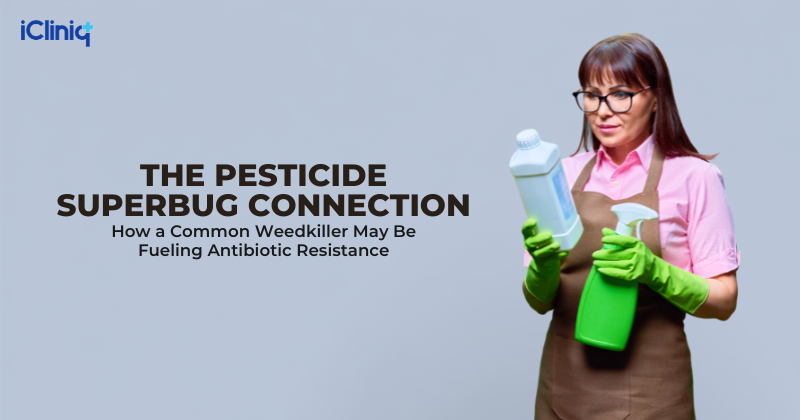
Surprisingly, attention is now turning toward something most people would never associate with superbugs. Weedkillers.
Recent studies have raised concerns about glyphosate, one of the most widely used herbicides in the world. Researchers found that some bacteria capable of surviving exposure to glyphosate were also resistant to multiple antibiotics. That’s an unsettling discovery.
What’s even more interesting is where these bacteria were found. They weren’t limited to hospitals or healthcare settings. Similar resistant strains showed up in environmental samples collected from agricultural areas as well.
How Could This Be Happening?
Bacteria are remarkably good at surviving.
Give them a challenge, and some of them will find a way around it. That’s what makes them so difficult to control.
When bacteria are repeatedly exposed to chemicals in their surroundings, they can develop defense mechanisms that help them stay alive. Scientists suspect that some of the same protective strategies that allow bacteria to tolerate glyphosate may also make certain antibiotics less effective against them.
Over time, the stronger bacteria stick around. The weaker ones don’t.
It’s basic survival, just happening on a microscopic level.
Why Are Experts Paying Attention?
At first glance, farms and hospitals seem to have very little in common.
One grows food. The other treats patients.
Bacteria, however, don’t care about those distinctions. They move through water systems, soil, wastewater, animals, and people. Boundaries that seem obvious to humans mean nothing to microbes.
That’s why researchers are concerned. If environmental chemicals are helping resistant bacteria survive and multiply, the problem may not be confined to healthcare settings anymore.
It could be happening much farther upstream.
What Does This Mean for Public Health?
The research is still evolving, and many questions remain unanswered. Scientists are continuing to investigate exactly how herbicides and antibiotic resistance may be connected.
Still, the findings highlight something important.
Fighting superbugs may require more than simply using antibiotics responsibly. Environmental factors could also be shaping how bacteria evolve and adapt.
What happens in agricultural fields doesn’t necessarily stay there. A chemical sprayed on crops today could have effects that ripple through ecosystems, water supplies, healthcare systems, and communities in ways we are only beginning to understand.
The battle against antibiotic resistance may be much larger than anyone initially imagined.
Publisher: Source link