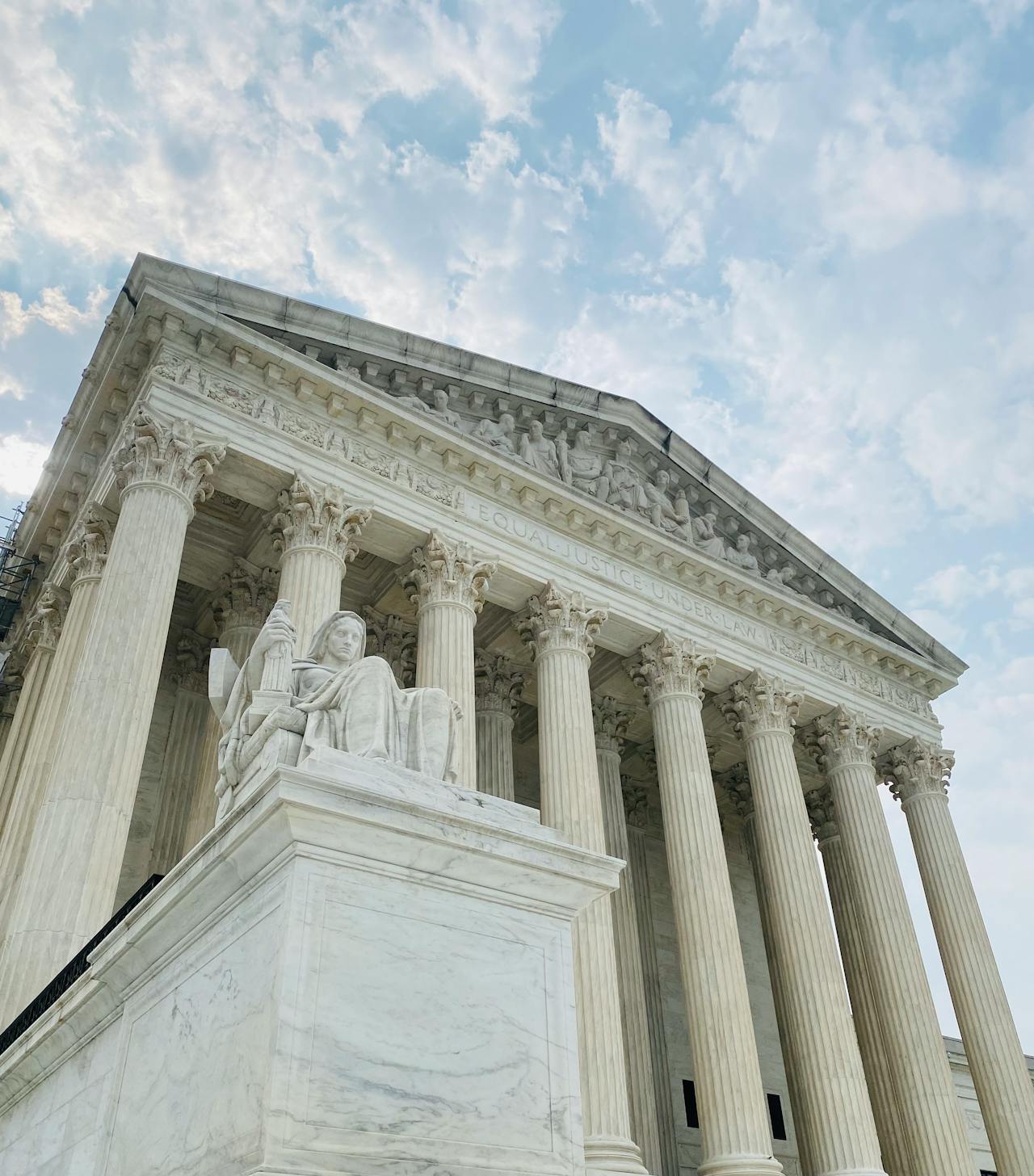
In a 6-3 ruling handed down Friday morning, the Supreme Court determined that President Donald Trump exceeded his authority when imposing the sweeping trade tariffs that have become a cornerstone of his administration’s foreign and economic policy.
Last year, the president unveiled the levies to address two issues he declared as national emergencies: drug trafficking and major trade deficits. He then invoked his authority to respond to the national emergencies under the 1977 International Emergency Economic Powers Act (IEEPA) to justify the tariffs.
Trump initially imposed tariffs on China, Mexico and Canada, but expanded the policy with “reciprocal” tariffs unveiled against numerous countries in April. Both collections of tariffs have been subject to various pauses and adjustments over the past year, often in response to trade or policy negotiations.
However, in a challenge to the policy that escalated to the top court, justices ruled that IEEPA did not grant Trump that authority.
“Absent from this lengthy list of specific powers [outlined in IEEPA] is any mention of tariffs or duties,” Chief Justice John Roberts wrote in the court’s opinion. “Had Congress intended to convey the distinct and extraordinary power to impose tariffs, it would have done so expressly, as it consistently has in other tariff statutes.”
The decision is likely to be celebrated in the healthcare and life sciences sectors, which frequently warned the administration of the substantial impact such policies could have on supply purchases. Those could range from higher prices for hospitals and consumers to difficulty securing necessary equipment, industry groups said while seeking exemptions.
Historically, IEEPA has allowed administrations to impose sanctions or limit specific deals or investments. Trump was the first president to employ IEEPA for tariffs on imported goods. The administration had been permitted to maintain the tariffs pending SCOTUS’ decision, and the Customs and Border Protection agency said in December that it had collected more than $200 billion via tariffs between Jan. 20, 2025, and Dec. 15, 2025.
Roberts noted that the Trump administration’s interpretation of IEEPA would “represent a transformative expansion of the President’s authority over tariff policy,” and disagreed with the administration’s argument pinpointing specific, non-adjacent words in the law’s text in the law’s text to carry its position.
(White House)
“Based on two words separated by 16 others in … IEEPA—‘regulate’ and ‘importation’—the president asserts the independent power to impose tariffs on imports from any country, of any product, at any rate, for any amount of time. Those words cannot bear such weight,” he wrote.
Liberal justices Elena Kagan, Sonia Sotomayor and Ketanji Brown Jackson agreed with the chief justice that the tariff policy wasn’t supported by the IEEPA’s text, and had violated the “major questions” doctrine that requires Congress make explicit its delegation of powers. Justices Neil Gorsuch and Amy Coney Barrett joined the part of the chief’s opinion centered on the major questions doctrine.
Conservative justices Brett Kavanaugh, Clarence Thomas and Samuel Alito dissented.
Of note, the court’s decision does not explicitly address a standing question hanging over tariff repeal: whether companies are permitted to seek the additional funds they paid under the invalidated levies, an issue often cited by the president’s team and raised by Kavanaugh in his dissent.
“The United States may be required to refund billions of dollars to importers who paid the IEEPA tariffs, even though some importers may have already passed on costs to consumers or others,” the justice wrote. “As was acknowledged at oral argument, the refund process is likely to be a ‘mess.'”
The Trump administration is broadly expected to consider other laws on the books to maintain its tariff policy—another point raised by Kavanaugh in his dissent.
“Although I firmly disagree with the Court’s holding today, the decision might not substantially constrain a President’s ability to order tariffs going forward,” he wrote. “That is because numerous other federal statutes authorize the President to impose tariffs and might justify most (if not all) of the tariffs at issue in this case—albeit perhaps with a few additional procedural steps that IEEPA, as an emergency statute, does not require.”
In earnings calls and commentary, several major health systems and group purchasing organizations have said they’ve been able avoid the brunt of the levies to date. This is due to the multi-year contracts with locked rates that were still in effect, and ongoing efforts to shift purchasing to manufacturers in the U.S. or other countries with lower tariff rates.
This is a developing story and will be updated.
Publisher: Source link