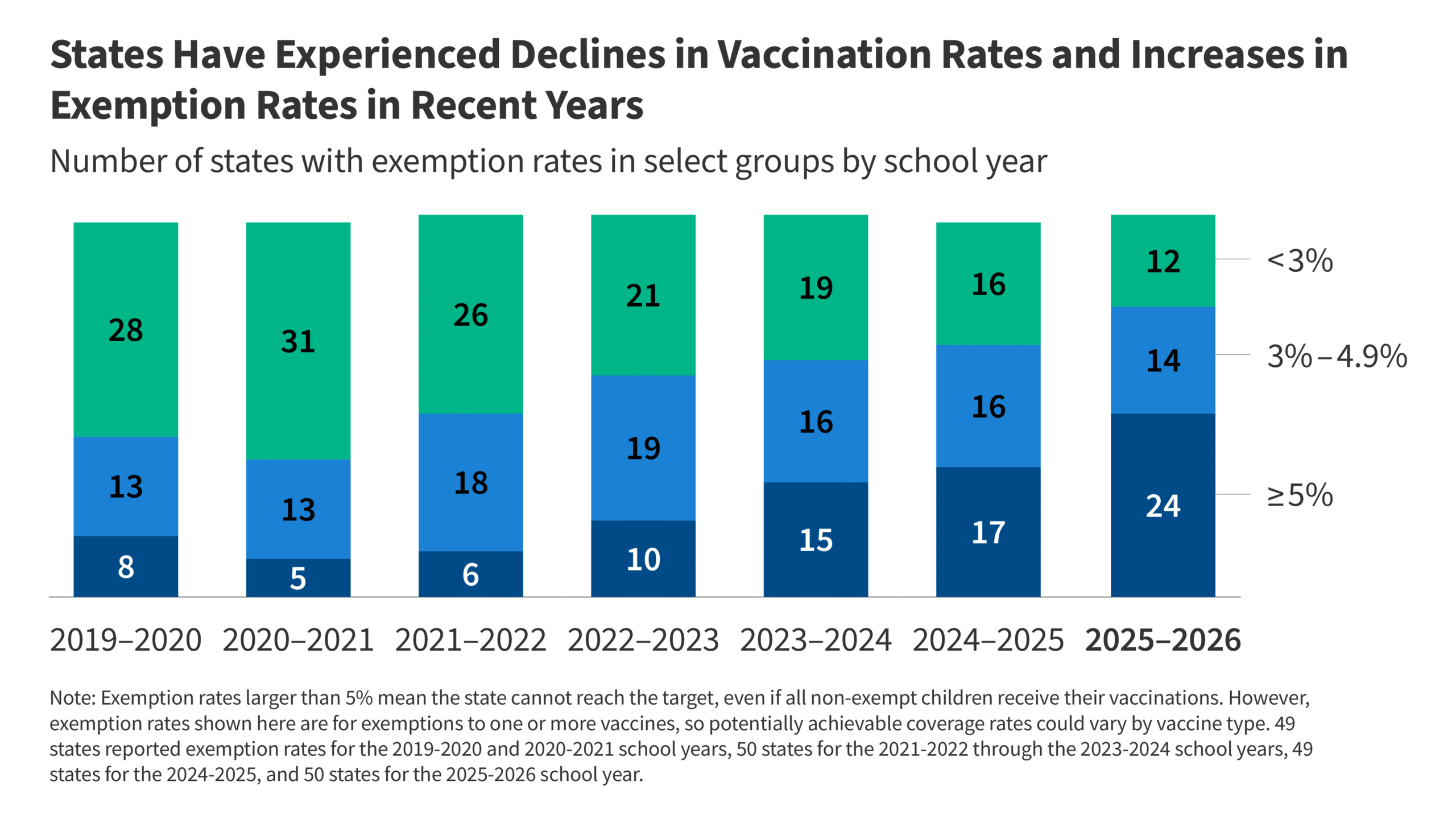
As measles cases rise across the U.S., children’s routine vaccination rates continue to decline while exemptions from school vaccination requirements, particularly non-medical exemptions, have increased. These trends began during the COVID-19 pandemic and have continued (Figure 1), signaling a shift in attitudes toward childhood vaccinations. This period has seen widespread vaccine misinformation and more skepticism among the public about the safety and effectiveness of measles vaccines as well as a decline in trust of health authorities in general and increasingly partisan views on vaccine requirements. Department of Health and Human Services (HHS) Secretary Kennedy and the Trump administration have also made significant changes to federal vaccine policy, including several attempts to change childhood vaccine recommendations and dropping Medicaid vaccine reporting requirements. Due to recent federal actions, most states have announced that they are no longer following federal recommendations as their benchmark for some or all childhood vaccines. As the school year begins, these changes along with changes to school vaccine exemption requirements in some states may increase confusion for families and could further drive down vaccination rates among children. This issue brief provides an update on the latest trends in kindergarten children’s routine vaccination and exemption rates as state and federal vaccination policy continues to evolve.
What are recent trends in kindergarten children’s routine vaccination rates?
The share of kindergarten children up to date on their vaccinations continues to decline. Data collected and aggregated annually by the CDC from state and local immunization programs found that 92.4% of kindergarteners had been vaccinated against measles, mumps, rubella (MMR) and polio and 92.0% against DTaP (diphtheria, tetanus, and acellular pertussis) for the 2025-2026 school year. This is down from 95% across all three vaccines for the 2019-2020 (pre-pandemic) school year and below coverage levels of the past decade. MMR vaccination rates also fall below the Healthy People 2030 “target” rate of 95%, the level needed to prevent community transmission of measles, leaving approximately 280,000 kindergarteners unvaccinated and unprotected against a highly contagious and life-threatening virus. While measles has been officially “eliminated” from the U.S. since 2000, measles cases have surged over the past two years. In 2026, the U.S. has reported more cases of measles than in any year since 1991, putting the U.S.’s elimination status at risk. Measles cases have been reported in most states, with South Carolina, Utah, Pennsylvania, Texas, and Virginia seeing the largest outbreaks so far in 2026.
Over three-quarters (39) of states had MMR vaccination rates below the “target” rate of 95% for the 2025-2026 school year (Figure 2). Further, 18 states reported rates below 90% for the 2025-2026 school year. This is compared to only 28 states below 95% and three states below 90% before the pandemic began. In the last year alone, over half of states experienced declines in vaccination rates for MMR, DTaP, polio, and varicella. There is also substantial variation in vaccination rates across states, with MMR coverage rates among kindergarteners for the latest school year ranging from a low of 75.2% in Idaho to a high of 98.9% in West Virginia. There can also be variation in vaccination coverage within states, and, when there are clusters of unvaccinated people within a specific community, the risk of an outbreak is higher.
What are recent trends in kindergarten children’s vaccine exemption rates?
At the same time, the share of kindergarten children with an exemption from one or more required vaccinations increased. The share of children claiming an exemption from one or more vaccinations rose from 2.5% in the 2019-2020 school year to 4.2% in the 2025-2026 school year, the highest national exemption rate to date. Increases in non-medical exemptions accounted for the recent increases; non-medical exemptions increased from 2.2% to 4.0% while medical exemptions declined slightly from 0.3% to 0.2% from 2019-2020 to 2025-2026. While a seemingly small increase in non-medical exemptions, any increases limit the overall share of children able to be vaccinated and make it more difficult to reach vaccination rate goals. Studies have shown that higher exemption rates are associated with lower vaccination coverage rates and increased risk for disease outbreaks.
Almost half (24) of states in the 2025-2026 school year had vaccine exemption rates over 5% (Figure 3). This is up from eight states during the pre-pandemic school year. Exemption rates over 5% make it impossible to reach vaccination coverage rates at or above 95% even if all non-exempt children were vaccinated (rates shown here are for exemptions to one or more vaccines, so potentially achievable coverage rates could vary by vaccine type). In the last year alone, most states experienced an increase in the share of kindergarteners claiming an exemption for one or more vaccines. States and local jurisdictions, not the federal government, set vaccine requirements and exemption criteria for daycare and school entry. As of 2026, all states and DC required children to be vaccinated against certain diseases, including MMR, to attend public schools, though exemptions are allowed in certain circumstances. All states allow a medical exemption, and almost all (46 states including DC) allow for a religious or personal belief exemption (or both). In recent years, some states have pursued changes to reduce or eliminate requirements or expand non-medical exemptions, which could further impact children’s vaccination trends.
Publisher: Source link