Key Takeaways
- In the months following two events that put vaccine safety in the spotlight—President Trump’s executive order calling for a change in U.S. childhood vaccine recommendations and the U.S. Senate investigation into Dr. Anthony Fauci—the latest KFF Tracking Poll on Health Information and Trust finds that while confidence in most childhood vaccines remains high, partisans are divided in their views of COVID-19 vaccine safety for both children and pregnant women. At the same time, notable shares of the public and parents express uncertainty or hold misperceptions related to the vaccine discussions at the center of these recent news events.
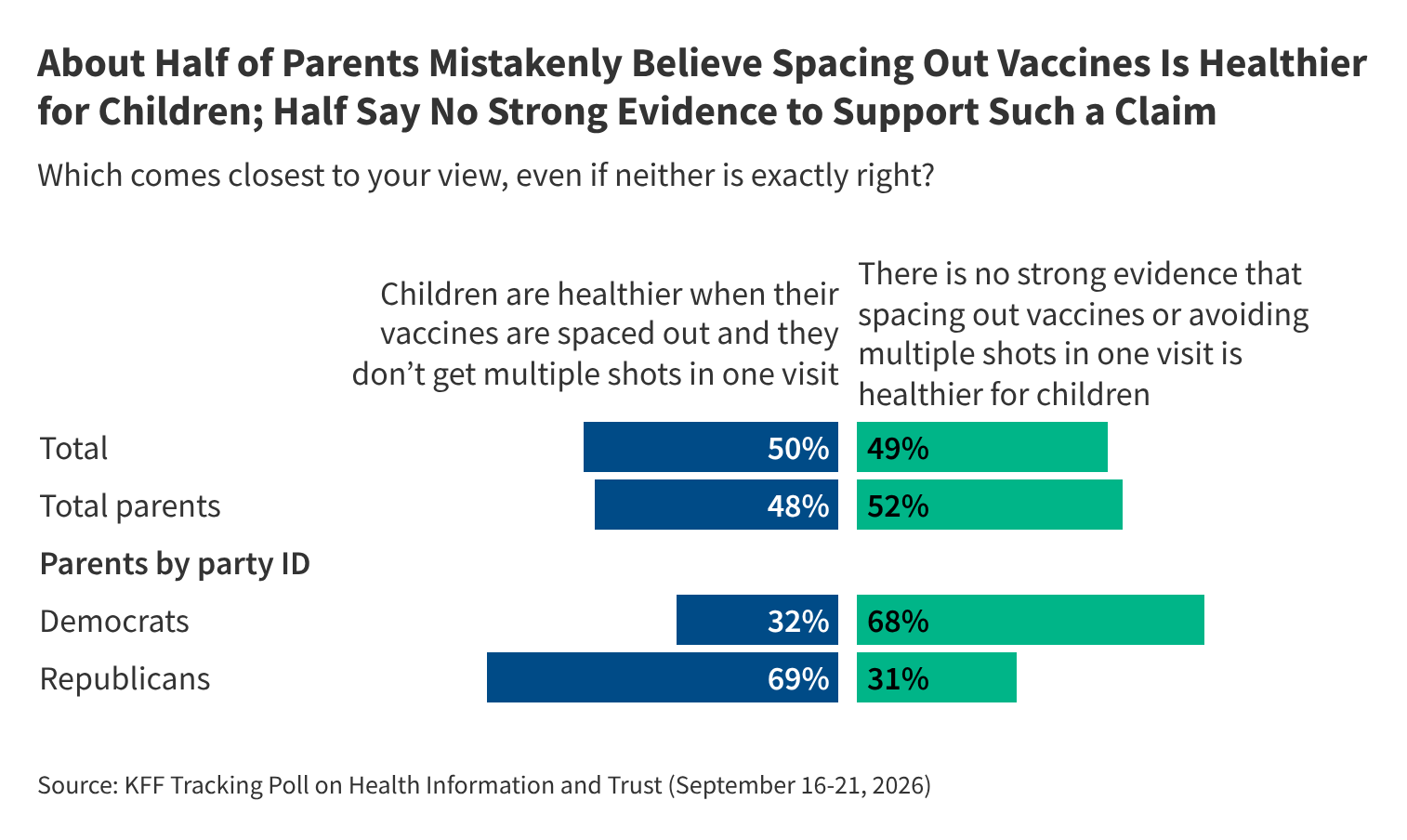
- As parents are faced with conflicting advice about how to handle their children’s vaccines, there are differences by partisanship on the best way forward. Overall, about half of parents think children are healthier when vaccines are spaced out and they do not get multiple shots in a single visit while the other half say there is no strong evidence that it’s healthier to do so. Larger shares of Republican parents say it’s better to space vaccines out and seven in ten Democratic parents say there’s no evidence to support this. While spacing out vaccines and refraining from getting multiple shots in one visit are key directives in President Trump’s executive order, there is no evidence to support such claims.
- Overall confidence in the safety of long-standing vaccines for children is bipartisan, with large majorities of parents and adults across partisanship saying they are confident the polio and MMR vaccines are safe for children. Smaller shares, though still majorities across partisanship, express confidence in the safety of hepatitis B and flu vaccines for children, but views of these two vaccines vary by partisanship with Republicans less confident than Democrats.
- Views of the safety of COVID-19 vaccines remain very polarized. While half of the public say they are confident the vaccines are safe for children, this is true of 77% of Democrats but just 21% of Republicans. Similarly, four in ten adults overall are confident these vaccines are safe for pregnant people, including 62% of Democrats but just 17% of Republicans. Most adults, including eight in ten women of reproductive age, also express uncertainty about whether getting vaccinated for COVID-19 while pregnant increases the risk of miscarriage—a false claim revived by some Republican senators amid Dr. Fauci’s trial.
- Many supporters of the Make America Healthy Again (MAHA) movement, a movement often associated with vaccine skepticism, have confidence in the safety of several vaccines for children, including three-quarters who are confident the vaccines for MMR (76%) and polio (76%) are safe and at least half who say the same of hepatitis B and flu vaccines. However, just three in ten are confident in the safety of COVID-19 vaccines for children.
Views of Childhood Vaccine Safety
Consistent with prior KFF polling, most adults remain confident in the safety of long-standing childhood vaccines, with at least three-quarters across partisanship saying they are “very” or “somewhat” confident that the polio and the measles, mumps, and rubella (MMR) vaccines are safe for children. Majorities of adults also express confidence in flu and hepatitis B vaccines for children, though there are larger partisan differences on these vaccines, with at least eight in ten Democrats saying they are confident compared to closer to six in ten Republicans.
Confidence in the safety of COVID-19 vaccines for children is deeply divided; half of the public are confident they’re safe for children, though just two in ten (21%) Republicans say this compared to half of independents and three-quarters (77%) of Democrats. Influenza (flu), hepatitis B, and COVID-19 are included in the list of immunizations the Trump administration is seeking to shift from routine use to shared clinical decision-making (and for children who meet certain risk criteria in the case of hepatitis B) in the most recent executive order changing the childhood vaccine schedule and in earlier attempts this year. The changes outlined in the executive order remain blocked in federal courts for now.
Notably, many supporters of the Make America Healthy Again movement (who make up 42% of the public)—a movement that has often been associated with vaccine skepticism—have confidence in the safety of several vaccines for children; three-quarters of this group express confidence in vaccines for MMR (76%) and polio (76%) and over half are confident in vaccines for hepatitis B (62%) and the flu (54%). A much smaller share (28%) of MAHA supporters are confident in COVID-19 vaccine safety for children.
Overall, confidence in the safety of all vaccines asked about in this survey for children remains largely unchanged from January and May of this year among parents, across partisans, among MAHA supporters, and among adults overall.
Similar to the overall public, there are notable partisan divides among parents of children under 18 when it comes to vaccine confidence; while large majorities of parents across partisanship are confident in the safety of childhood vaccines for MMR and polio, parents who are Democrats or Democratic-leaning independents are at least 20 percentage-points more likely to express confidence in hepatitis B and flu vaccines for children compared to their Republican counterparts. And, like partisans overall, the divides are largest for COVID-19 vaccines, with Democratic parents three times more likely to say the vaccines are safe compared to Republican parents (64% vs. 19%).
In addition to their general confidence in the safety of long-standing childhood vaccines, eight in ten (82%) adults overall and three quarters (76%) of parents think the benefits of childhood vaccines for MMR outweigh the risks while about one in five (17% of all adults; 22% of parents) say the risks outweigh the benefits. These shares have largely stayed consistent since the beginning of the second Trump administration, before many changes to the vaccine policy recommendations. Large shares of parents across partisanship say the benefits of MMR vaccines outweigh the risks, though Republican or Republican-leaning parents are somewhat more likely than Democrat or Democratic-leaning parents to say the risks outweigh the benefits (24% vs. 14%).
Even among parents who support the Make America Healthy Again movement, seven in ten (69%) say the benefits of MMR vaccines outweigh the risks, though the share of MAHA parents who say the risks outweigh the benefits is larger than among parents who do not support MAHA (29% vs. 16%).
Awareness and Perceptions of the Recent Vaccine Executive Order
The executive order signed by President Trump in August calls for the reduction in the number of diseases targeted by routine childhood vaccination from 17 to 11 and calls for the measles, mumps, and rubella (MMR) vaccines to be administered as separate vaccines, among other directives.
Most (59%) of the public, and a similar share of parents, have heard either “not much” (30%) or “nothing at all” (28%) about the most recent attempts by the administration to change the childhood vaccine schedule, while a smaller share (41%) of adults say they have heard “some” (30%) or “a lot” (12%) about it. By comparison, about half (51%) reported hearing at least “some” about similar changes to the vaccine schedule announced in January.
While many adults are unsure about the federal government’s recent executive order on childhood vaccines, views of how these changes might affect children’s health are more negative than positive. Four in ten overall think these changes will have a negative impact on children’s health in the U.S., one in eight (12%) say they will have a positive impact, one in ten (9%) say they will have no impact, and four in ten (38%) are unsure. These perceptions vary greatly by partisanship, with Democrats and independents much more likely to view the impact as negative rather than positive. Republicans are more likely to say the changes will have a positive impact (27%) than a negative one (9%), but half of Republicans say they are unsure.
Notably, half of parents say the changes to the childhood vaccine schedule will have either no impact (14%) on children’s health in the U.S. or are unsure of the impact they will have (36%). Among supporters of the Make America Healthy Again (MAHA) movement, half (48%) are unsure of the impact the changes will have, while smaller, similar shares say it will have either a positive (23%) or negative (18%) impact.
Among the 41% of the public who have heard “a lot” or “some” about the recent executive order, six in ten (60%) say the changes will have a negative impact on children’s health, about three times the share who expect a positive impact (18%).
Alongside reductions to the number of diseases targeted by routine childhood vaccination, the recent executive order calls for separate doses for the currently combined MMR vaccine. This directive also comes at a time when the President has made statements that spacing out and separating doses of childhood vaccines would reduce autism rates. The KFF Tracking Poll on Health Information and Trust finds parents are divided in their perceptions of whether it is healthier for childhood vaccines to be spaced out. Half of parents (48%) incorrectly think children are healthier when their vaccines are spaced out and they don’t get multiple shots in one visit, while another half (52%) says there is no strong evidence to support such a claim. There is no evidence that spacing out vaccines is safer for children, however this perception among parents is not new; previous KFF polling has found concerns about receiving multiple vaccines at once is one of the top reasons parents report skipping or delaying childhood vaccines.
Awareness of whether childhood vaccines are safer when spaced out varies by partisanship, with seven in ten (68%) Democratic or Democratic-leaning parents saying there is no strong evidence that it is healthier for children to space out vaccines or avoid multiple shots in one visit, while a similar share of Republicans or Republican-leaning parents (69%) say children are healthier this way.
Misperceptions About COVID-19 Vaccine Safety in Pregnancy
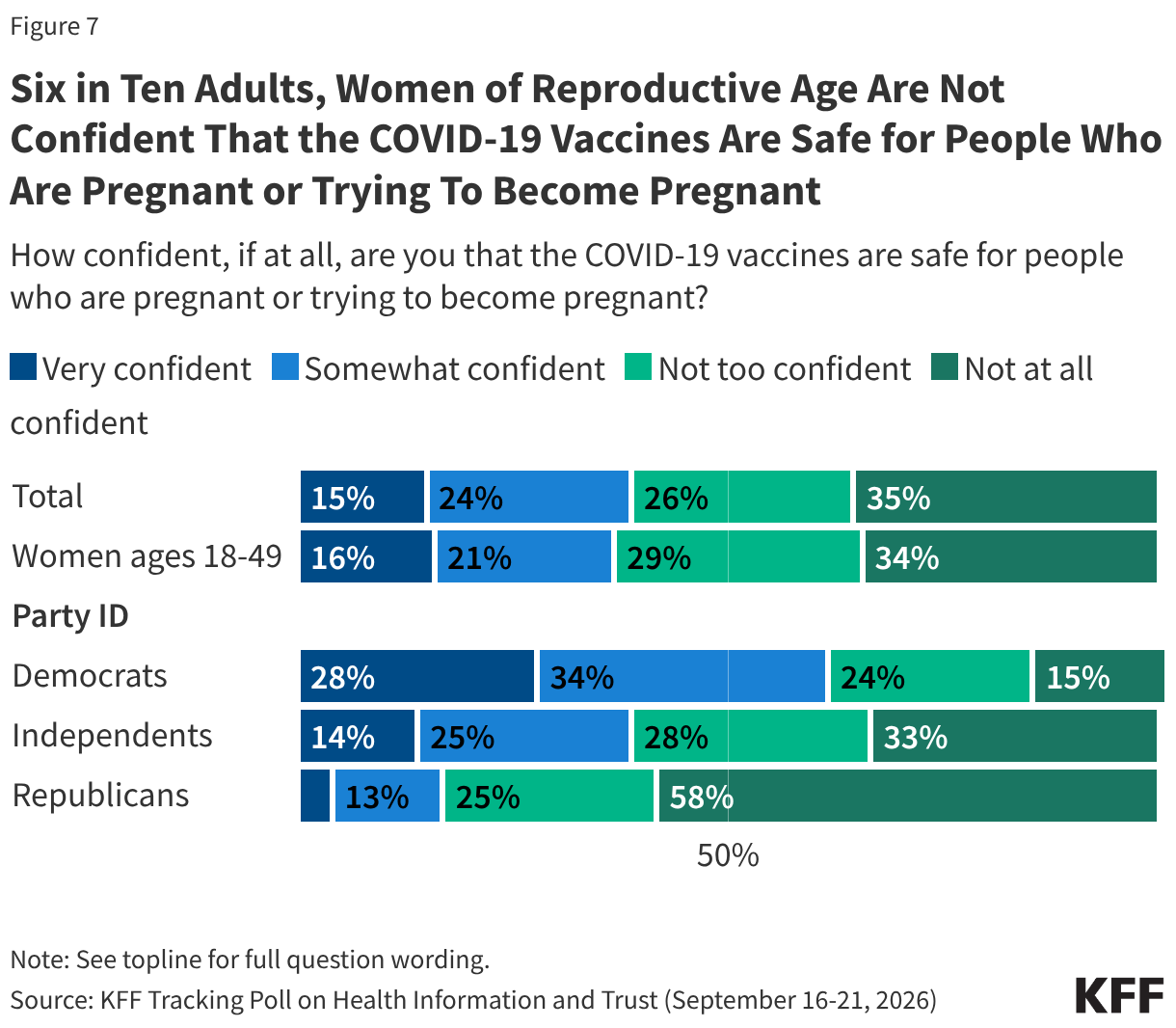
Misinformation about the COVID-19 vaccine and its effects on pregnancy, breastfeeding, and fertility have been widespread over the years, including recent claims tying the vaccine to first trimester miscarriages. About four in ten (39%) adults say they are either “very” or “somewhat” confident that the COVID-19 vaccines are safe for pregnant people, a decrease from 53% in May 2022. Among women of reproductive age, 37% now have confidence in the vaccines’ safety during pregnancy, down from 48%. As with most attitudes toward COVID-19 vaccines, there are large partisan gaps, with more than six in ten (62%) Democrats expressing confidence and more than eight in ten (83%) Republicans saying they are not confident. Notably, confidence in COVID-19 vaccine safety for pregnant people has decreased across partisans since 2022, including a 17-percentage point decrease in confidence among Democrats and a 15-percentage point decrease among Republicans.
The decrease in confidence in COVID-19 vaccine safety for pregnant people comes amid revived false claims linking COVID-19 vaccination to miscarriage, a claim which leaves many adults uncertain. About a third of the public have heard the claim that getting vaccinated for COVID-19 while pregnant increases the risk of miscarriage, including about four in ten Republicans (43%), a third of independents (34%), and one in five Democrats (22%). Three in ten (31%) women of reproductive age (ages 18 to 49) also say they have heard this.
While research has consistently found COVID-19 vaccines to be safe for pregnant people, many adults are still uncertain about potential links between the vaccines and miscarriages. A small share of the public, just 8%, say it is “definitely false” that getting vaccinated for COVID-19 while pregnant increases the risk of miscarriage, and a similar share say the claim is “definitely true” (9%).
In line with KFF’s Health Information and Trust research on a variety of health topics, many adults fall in the “malleable middle” when it comes to this claim, saying it is either “probably true” (37%) or “probably false” (44%). The large share of adults who express uncertainty about this claim is consistent across partisanship, though a somewhat larger share of Republicans say it is “definitely true” (18%) while more Democrats say it is “definitely false” (13%). A large majority of women of reproductive age also express uncertainty about this claim, with equal shares saying it is either “probably true” (40%) or “probably false” (42%).
Publisher: Source link