Corporate communications and investor relations professionals increasingly understand the importance of creating content to attract the attention of AI. But by over-optimizing for large language models, we risk losing the all-important human voice, and in doing so, undermining the very credibility that communication conveys in the first place.
At ICR Healthcare, we advise biotech, pharma and medtech companies on how to communicate with investors, journalists and the broader ecosystem. We are increasingly navigating the consequences of AI-generated copy on both sides of the equation: as advisors helping clients craft genuine narratives, and as readers wading through a growing flood of machine-produced “insight” that says a great deal while conveying very little.
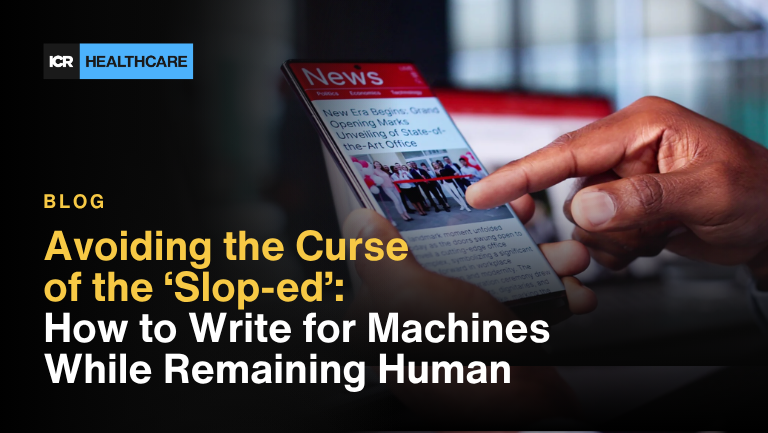
The backlash is already here. London business newspaper, City AM has become a standard-bearer in a new war against AI-generated copy. The publication’s editors have run out of patience with material spat out by ChatGPT or Claude, positioned as ‘thought leadership’ and submitted for publication, and the newspaper is now shaming contributors for sending what it dubs ‘slop-eds’. An off the cuff soundbite, but a real risk.
‘Thought leadership’ has always been hard to define, but if the thought belongs to a machine, or an aggregation of human thoughts by a machine, it is oxymoronic and dull. Worse, it’s also a reputational risk to businesses if they can’t articulate genuine human insight: it’s not only that your copy is more likely to be rejected or publicly shamed by a newspaper or on social media, but that your authority as a leader is called into question.
A leader who cannot define strategic objectives or articulate strongly held positions without the help of an algorithm has no authority with stakeholders, whether those be investors, journalists, partners or patients. It devalues the entire information ecosystem if human insight is tabbed out of the discussion. In healthcare, that erosion of authority is especially acute, because the audiences at stake include not just investors and media, but patient communities and clinicians who shape real-world outcomes.
Businesses are built and led by human beings to serve human beings. Leveraging AI for efficiency is smart, but no one wants to follow the strategic insights of an algorithm.
We absolutely must tailor our communication style for the era of AI. But there is a middle ground which enables us to be both human and AI-ready in the way we communicate.
A few pointers on avoiding the curse of the ‘slop-ed’ (and not getting caught by the AI detectors):
Remember that all stories are human stories
Human experience is what makes words resonate. Your personal experience, in whatever field you work in, is your most valuable asset, and your language is your personal fingerprint. Use it or lose it.
Take a position
AI written content tends to try to present arguments neutrally while reverting to a pleasing, inoffensive mean. If you care enough about something to write an op-ed, get behind your argument.
Vary the pace and rhythm of what you write
AI copy tends to use repetitive patterns, with sentences of roughly similar length and rhythm. Human writing is ‘burstier’, and less predictable. More uniform writing without pace tends to draw the attention of AI detection software.
Use the AI structure, lose the blandness
AI is great at ordering and structuring. It’s fine to lean into that structure and take advantage of AI’s speed in formatting. Just don’t expect it to substitute for thought, argument, and experience.
Apply the same discipline to investor communications
Earnings scripts, shareholder letters and IR materials are where AI-generated blandness does the most damage, because investors are specifically reading for conviction, not consensus. Generic language signals a lack of leadership input and no clear differentiation. Corporate presentations must tell your story.
This discipline is harder to sustain than it sounds. An IRO focused on institutional capital markets and a CCO oriented toward public narrative may not instinctively see their functions, or their stakeholder remits, as connected. By today’s ecosystem demands it. Investors do read media coverage. Journalists do attend earnings calls. Analysts synthesize both. When the most senior leaders in an organization agree to prioritize narrative coordination as a strategic imperative, not just a nice-to-have, integration becomes self-reinforcing. Without that C-suite alignment, even the most disciplined team-level coordination will face friction.
At ICR Healthcare, working across both investor relations and corporate communications, this is the work we do with leadership teams at the moments that matter: helping them define their story, articulate it in their own voice, and deploy it at the moments that matter, whether that’s an earnings call, a conference keynote, or an op-ed. The leaders who do this well build durable credibility. The ones who outsource the thinking to an algorithm are storing up a problem.
To discuss how ICR Healthcare can help you navigate the balance between AI efficiency and authentic human voice, contact Jessica Hodgson, Partner.
Publisher: Source link