Amidst challenging fiscal conditions and upcoming national and state elections, states are working to implement major federal changes to Medicaid. The 2025 reconciliation law made major changes to federal revenues and spending. Shortly after enactment, the Congressional Budget Office (CBO) estimated the new law would reduce federal spending on Medicaid by $911 billion over the 2025–2034 period and that the Medicaid changes would increase the number of people without health insurance by 7.5 million in the year 2034. Recognizing the risks such changes posed for rural areas, policy makers added a $50 billion rural health transformation program (referred to here as the “rural health fund”) to the reconciliation law. All 50 states have received first-year allotments from the rural health fund and are implementing new initiatives to support rural health care, although these funds will not offset reductions in federal Medicaid support.
Even before the new restrictions take effect, the landscape is evolving, making it difficult to isolate the effects of the changes in the law. Medicaid enrollment is declining, and states are facing tight fiscal conditions due to slowing revenue growth and increased spending pressures. The forthcoming policy changes from the 2025 reconciliation law are expected to increase coverage loss, decrease provider reimbursement rates, and place new strain on state budgets. Some more recent estimates of the law’s provisions—such as those included in proposed or final regulations—are not comparable to the older CBO estimates because they cover different time periods, use different baseline projections of spending and health coverage, and have different assumptions about how states, providers, and people will respond to the changing Medicaid policies.
Although current estimates of the effect of the law on Medicaid are not available—and are unlikely to be available in the future, this policy watch illuminates how the impacts will vary across states by showing which key eligibility and financing provisions are expected to affect each state and Washington DC (hereafter referred to as a state). Some provisions in the law affect all states, while some provisions only apply to certain states. The effects of many provisions vary by state and states that have adopted the Affordable Care Act (ACA) Medicaid expansion face the most restrictions (Figure 1). In many cases, the full effects of the law are still unknown and will depend on how federal rules are finalized and how states implement the changes. Many of the changes are administratively challenging for states to implement. Those challenges could be amplified in the 36 states with gubernatorial elections in 2026 if the election results in a change of administration. With only 17 incumbent governors currently on the ballot, at least 19 states are expecting some change in leadership.
Which States Will Be Affected by Key Medicaid Eligibility Changes?
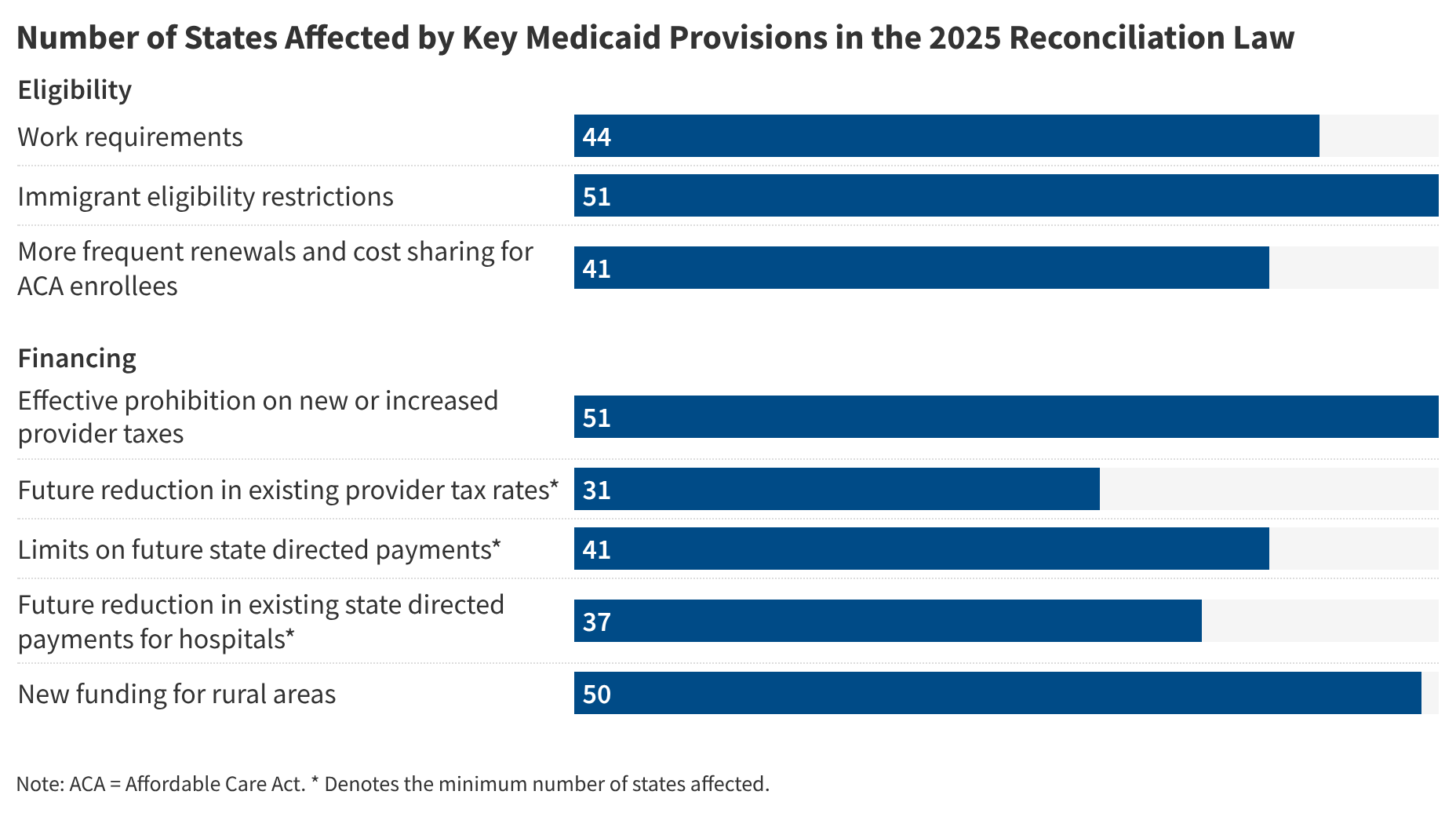
The reconciliation law included Medicaid eligibility policies that will lead to fewer people being covered by Medicaid and disproportionately apply to Medicaid expansion states. The most substantial changes include new work requirements, more frequent eligibility redeterminations for expansion adults, and restrictions on Medicaid eligibility for immigrants (Figure 2). The law also reduces the availability of retroactive coverage to pay incurred medical expenses to two months for traditional enrollees and one month for expansion enrollees and imposes new cost-sharing requirements on expansion adults with income 100–138% of the federal poverty level (FPL, Appendix Table 1). While states will face increased administrative costs to implement these changes, lower Medicaid enrollment could reduce state and federal Medicaid costs. However, the drop in Medicaid enrollment over time may shift costs from states to providers as more people become uninsured but still have health care needs. States required to implement key Medicaid eligibility changes include:
- Forty-four states are required to implement new work requirements on certain adults. These states, including 41 expansion states and 3 non-expansion states, will be required to condition Medicaid eligibility for enrollees with coverage through the ACA Medicaid expansion or under certain waivers on meeting work requirements or qualifying for an exclusion.
- Forty-one Medicaid expansion states will need to increase the frequency of eligibility redeterminations for expansion adults from annually to every six months. This new 6-month renewal period only applies to expansion adults; states must maintain the 12-month renewal period for other populations eligible on the basis of modified adjusted gross income (MAGI), including most children, pregnant individuals, and parents who are not enrolled in expansion coverage.
- All states must restrict eligibility for certain lawfully present immigrants. As of October 1, 2026, all states are required to limit Medicaid eligibility to only certain lawfully present immigrants, eliminating eligibility for many other groups of lawfully present immigrants, including refugees and asylees without a green card, among others.
Which States Will Be Affected by Key Medicaid Financing Changes?
The reconciliation law makes major changes to Medicaid financing that will affect how states can raise the state share of Medicaid payments and how they can pay providers. Changes to Medicaid financing include new limits on provider taxes that constrain all states in their ability to raise future revenues from provider taxes and further limit the amount of revenues ACA expansion states are permitted to collect. Those new limits are likely to exacerbate states’ current fiscal challenges and may force states to make additional reductions in Medicaid spending. Changes to provider payment rates primarily stem from new limits on state directed payments (SDPs), which cap future payment rates at or near the rates paid by Medicare in all states. Unless states can offset this funding loss, providers are likely to face a significant drop in Medicaid payments at the same time they are experiencing revenue losses resulting from fewer people having health insurance. Although the rural health fund does not offset the loss of federal Medicaid revenues, it may help the 50 states that are receiving funding to adapt their systems to the loss of revenues. However, the extent to which any benefits from these initiatives persist after the time-limited funds are exhausted remains unknown.
Beyond limiting states’ future use of provider taxes, the law may reduce revenues from existing taxes in nearly all states that have adopted the ACA Medicaid expansion. New limits on provider taxes effectively prohibit all states from establishing new provider taxes or increasing the rates of existing taxes, thus limiting one tool states may have used to respond to the 2025 reconciliation law’s reduction in federal funding. For ACA expansion states, the 2025 reconciliation law decreases the percent of net patient revenues (currently 6.0%) that can be collected for all provider taxes except those on nursing facilities and intermediate care facilities. Starting October 1, 2027, the limit will decrease by 0.5 percentage points each year, until it reaches 3.5%. At least 31 states have current taxes on hospitals, managed care organizations, or ambulances that are above 3.5% of net patient revenues (Figure 3). Additional states have other provider taxes that could be affected, and a proposed rule to implement the reconciliation law requirements would expand the new limits to include health insurer taxes.
At least 41 states have SDPs, which govern the payments managed care organizations make to health care providers and could be affected by new limits in the 2025 reconciliation law. Most SDPs are for hospital services, and most set payment rates at or near rates paid by private health insurance plans. Starting January 1, 2028, payment rates for hospital services will decrease in at least 37 states with directed payments that exceed the new limits. KFF estimates that the federal government spends $93 billion on SDPs each year, $78 billion of which pays for hospital services. Of the $78 billion on hospital services, an estimated $60 billion exceeds the new payment limits and could be reduced as the reconciliation law limits take effect. Some states will be far more affected than others, with over half of the spending above new limits coming from only eight states (California, Illinois, Kentucky, Texas, North Carolina, Louisiana, Arizona, and Michigan).
All 50 states (not including Washington DC) are receiving money from the rural health fund, but the amount they are receiving per rural resident ranges from $66 (Texas) to $6,305 (Rhode Island). The rural health fund will provide grant funding to states for a period of five years, with $10 billion awarded across the states each year. First-year awards range from $147 million in New Jersey to $281 million in Texas (Appendix Table 2). Ten states’ awards are less than $100 per rural resident, but eight states’ awards are greater than $500 per rural resident. The range in funding reflects a financing formula that awards 50% of the total amount equally among all states, 25% based on “state need” (which reflects the characteristics of the states’ rural geographies, populations, and providers), and 25% based on states’ proposed initiatives (which reflects states’ plans and their use of initiatives consistent with the priorities of the current administration).
This work was supported in part by Arnold Ventures. KFF maintains full editorial control over all of its policy analysis, polling, and journalism activities.
Appendix
Publisher: Source link