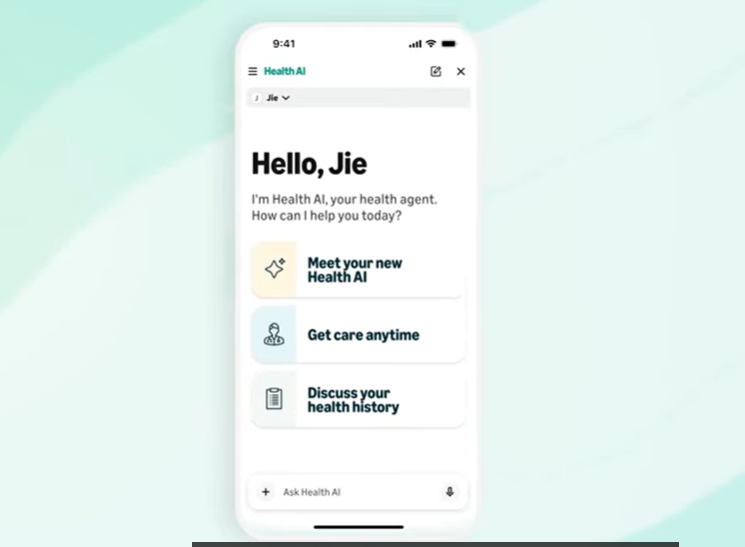
In January, Amazon launched an agentic health AI assistant for One Medical members and the tech giant is now expanding access to U.S. consumers through Amazon.com and the Amazon app.
Amazon’s Health AI is an agentic AI health assistant that can help users understand their medical records, give personalized health insights and connect users to licensed healthcare professionals. Health AI accesses patients’ medical records through state health information exchanges to review diagnoses, medications and health history before responding to users’ health questions. Health also can help book appointments and manage prescriptions. When patients need care, Health AI can connect them to licensed One Medical primary care providers.
Amazon Health executives say the combination of AI-enabled care delivery and provider-led care, via virtual visits, offers “personalized medicine at consumer scale.”
“The launch of Health AI represents a complete re-imagination of healthcare,” Prakash Bulusu, chief technology officer at Amazon Health Services, wrote in a LinkedIn post. “For the first time, I have a truly personal health agent in my pocket; available 24/7, backed by real providers. The real aha moment came when I ran it against my own health data. I had done my annual physical with One Medical months earlier but never completed the labs; honestly, I had forgotten about them entirely. Health AI surfaced that in my very first session. I booked the appointment and got it done. Just like that.”
Consumers can sign up for the Health AI waitlist on the Amazon Health page. The goal is to make Health AI available to all U.S. customers soon, Amazon executives said.
Based on Amazon’s initial rollout of the Health AI feature with One Medical members, many individuals’ health needs can be met by engaging with the AI assistant without needing to consult with a physician, especially if they give Health AI access to their medical records, according to Andrew Diamond, M.D., chief medical officer at One Medical.
“We’ve quickly concluded that this should be available to a much larger audience of folks, especially if it helps people discover what it’s like to get care from One Medical,” Diamond told Fierce Healthcare. “In the last couple of months that it’s been available to One Medical members, the feedback that we’ve received has been really good. Members are telling us that they’re loving the experience, that they’re getting really high-quality advice and guidance and they’re getting their needs met with a very high rate of success.”
If Health AI recommends that a patient be connected to a One Medical provider, the patient can choose to have a summary of the conversation sent to that provider, or the patient can opt out. “That’s an important choice for the patient to have because what we found is some people are actually inclined to disclose things to AI that they may not feel comfortable talking about, even with their PCP,” Diamond said.
That summary also is combined with insights from the patients’ medical record, if available, such as medications they are taking or allergies, to provide relevant information to the One Medical provider.
Amazon Health executives contend that the company has a strong safety framework in place.
All interactions with Health AI happen within a HIPAA-compliant environment. Users’ conversations are protected by encryption and strict access controls. Protected health information from Amazon One Medical and Amazon Pharmacy is not used in the broader Amazon store to market general merchandise or by Amazon Ads, and Amazon does not sell customers’ personal data, the company said.
“Just as human clinicians learn from real cases while protecting patient privacy, we train Health AI models on abstracted patterns without directly identifying information,” Bulusu and Diamond wrote in a blog post. “For example, if multiple patients ask about medication interactions, we may use those patterns—without patient names—to improve how Health AI responds to similar questions. We only use protected health information for purposes permitted under HIPAA.”
Amazon co-developed Health AI with technical, operational and One Medical clinical leaders, executives noted. Before launch, the Amazon clinical team evaluated Health AI’s performance across an extensive range of synthetically generated conversations spanning clinical safety, emergency response and compliance. The company’s evaluation framework requires Health AI to meet or exceed clinician-level performance on safety-critical decisions before deployment.
Health AI incorporates multiple patient safety guardrails, Bulusu and Diamond wrote. If it is uncertain about any clinical recommendation, it will direct customers to a human provider rather than provide potentially incorrect guidance.
“Every interaction is being evaluated, although we’re automating the evaluations. We’re at a point now, with many hundreds of thousands of interactions under our belt through the One Medical membership and simulated interactions, where we’re only having to escalate a fraction of the interactions that are being evaluated to a group of human clinicians who are now supervising the safety program. The performance there is really extraordinary as we’re holding it to the same standards, or higher standards, than we would hold human clinicians,” Diamond said.
Health AI was built with a “multi-layered evaluation and monitoring framework, a multi-level agent architecture with functional agents, subagents, inspectors auditors and judges,” Bulusu wrote in his Linked post. “This isn’t a chatbot with a healthcare skin. It’s a system designed from the ground up to be safe, trustworthy, and useful,” he wrote.
AI and big tech companies are running to win the healthcare AI race as OpenAI launched ChatGPT Health for patients and Anthropic rolled out Claude for Healthcare designed for providers and payers. Microsoft also this week unveiled an AI health assistant, Copilot Health, that brings together health records, wearable data and health history.
Diamond contends that Amazon’s Health AI is distinctive as it was purpose-built for healthcare and co-developed with a clinical team. With its One Medical provider business, Amazon can connect the AI assistant experience with medical care provided by a licensed clinician.
“It was built for general healthcare by a large group of primary care clinicians who are accustomed to doing a lot of virtual healthcare. We’ve been in the virtual healthcare business for 17 years now. And it’s also connected to that clinical team so that if you need actual care from a licensed practitioner, or if you need a prescription, you can get that and have the entire episode of care closed out, so to speak, inside this Health AI experience,” he said.
He asserts that Amazon maintains “extraordinarily high standards” for ensuring the security and privacy of customers’ information.
Bulusu noted that Amazon aims to earn and maintain the trust of providers and patients with its Health AI agent.
“We have thousands of clinicians working in One Medical. When we started building this, we needed to actually earn first-party trust, with both our patients and providers, and the way to do it is to make sure that the quality, the safety, the security and privacy, all of these bars are not just HIPAA-compliant, but the highest possible bar that Amazon would like to have with any of our businesses,” he said.
As it launches Health AI more broadly, Amazon also is expanding access to virtual consultations. Eligible U.S. Amazon Prime members who use Health AI will get access to five free direct-message care consultations with a One Medical provider for more than 30 common conditions. These consultations could cover medical issues such as cold and flu, allergies and acid reflux, pink eye and UTIs, anti-aging skin care and hair loss among others. The five free virtual consultations are part of an introductory offer from Amazon.
Non-Prime members or those who want direct-message care outside of the introductory offer can pay $29 for an Amazon One Medical Pay-per-visit telehealth visit.
Amazon’s offerings mark a key change to primary care access, Diamond contends.
“Having this kind of care available to everybody, regardless of their location, 24/7, 365, I think that has the potential to dramatically improve folks’ health and also just prevent a lot of the misery and frustration that happens in healthcare when you let things build up and you end up in an ER or a hospital because you neglected something,” he said. “I think the potential is immense because it’s not just those acute emergency situations.”
Amazon plans to add capabilities to Health AI to support users’ nutrition and exercise plans as well as medical management with AI-enabled coaching, Diamond said.
AI assistants can help address consumers’ lower acuity health needs. “People can come in [to see their doctor] as better-informed consumers of healthcare,” Diamond noted. “Patients are going to be coming in with most of their low-level questions answered, those questions that often just clog up providers inboxes and message queues. Patients are going to be coming in and already understanding their test results, already understanding their treatment options, already understanding their diagnoses, and going to be able to sit down with their providers for much more meaningful conversations about what they really should be choosing to do from the options that are presented to them. I think it’s going to really enhance the human aspect.”
Healthcare providers should be paying close attention to these new health AI assistants, according to Forrester’s principal analyst Arielle Trzcinski, who supports the healthcare vertical.
“AI-powered experience adoption in healthcare is a first-to-market race and big tech is winning against traditional providers,” Trzcinski said. “Consumers are already using AI to interpret symptoms, decide when to seek care and evaluate options. Providers that delay embedding similar tools into their own digital front doors risk losing influence over patient decisions – not because any one tool is perfect, but because they’re available.”
According to Forrester data, when consumers were asked whether they would trust an AI tool for initial guidance on symptoms or care needs, trust levels were nearly identical between tools offered by their healthcare provider and public AI tools – 26% versus 28%, respectively.
Consumers are more comfortable using AI for care navigation decisions, particularly when the tool comes from their healthcare provider. Among Gen Z, 51% are comfortable using provider‑based AI to determine whether to seek care, compared with 46% for public AI tools. That preference extends to guidance on where to go, where provider tools maintain a slight advantage (46% versus 41%), according to Forrester.
“These announcements [from Amazon and Microsoft] signal a shift in how consumers think about access. These experiences must now offer continuous, AI‑mediated guidance. That reframes competition across healthcare and challenges incumbents to rethink how, where and when they show up for patients,” Trzcinski said.
“As consumers turn to conversational AI tools including Copilot, ChatGPT, Claude and others for guidance, healthcare organizations must use a multipronged digital strategy to reach customers across both owned channels and third‑party platforms,” she said.
There are plans to connect Health AI users to specialty care through Amazon One Medical’s network of health system partners, according to the blog post. That capability supports continuity of care, Amazon executives noted. Rush University System for Health, Cleveland Clinic, Montefiore and Hackensack Meridian Health are among the company’s health system partners.
Some health system leaders see the potential for Health AI to improve patient experiences.
“Our partnership with Amazon reflects our shared vision of making health care more accessible and convenient for the communities we serve,” Omar Lateef, D.O., president and CEO of Rush University System for Health. “Tools like Health AI represent an exciting opportunity to help patients navigate their health journey more effectively while staying connected to their care teams. The future of health care is about meeting patients where they are—combining innovation with personalized, community-centered care that people depend on.”
“As innovative digital tools evolve, they have the potential to ease patient flow and enable seamless transitions between primary and specialty care. These kinds of partnerships are an important avenue for creating a more coordinated, high-quality health care experience that our patients deserve,” said James Gutierrez, M.D., Chief of Cleveland Clinic’s Primary Care Institute.
Publisher: Source link